• Quick Tour
  • Media Room
  • Composers
  • Musical Crossroads
  • Quick Tour
  • Composers
  • Media Room
  • Musical Friends
  • Education
  • Glossary
  • Musical Crossroads
  • Project Partners
  • Contact Us
  • Credits
  • Mondriaan Fonds
    Mondriaan Fonds
Site by: Rytm Interactive
Biography
bio
Pärt telling his childhood memories
video
Bicycle-ballet at Rakvere town square for Pärt's 75th birthday
video
Pärt and his musical diaries
video
Tintinnabuli – technique, style or ideology?
text
Arvo Pärt on his tintinnabuli music
video
Peter Phillips on the interpretation of tintinnabuli music
video
Manfred Eicher on Arvo Pärt's music
video
Steve Reich greeting Arvo Pärt on his 80th birthday
video
Björk and Pärt in conversation
video
Perpetuum mobile
audio
Collage in Arvo Pärt’s music
text
Collage über B-A-C-H
audio
Credo. Guided listening
guided listening
Credo
video
Symphony No. 3
audio
Pärt on tintinnabuli and Für Alina
video
Für Alina
video
Fratres
audio
Archive recording (excerpt) of Fratres
video
Cantus in Michael Moore's documentary Fahrenheit 9/11
video
Cantus in Memory of Benjamin Britten
video
Tabula rasa
audio
Spiegel im Spiegel
video
NY City Ballet dancing Spiegel im Spiegel (excerpt)
video
Es sang vor langen Jahren
audio
Te Deum
video
Miserere
audio
Mozart-Adagio
video
Kanon pokajanen
audio
Lamentate
audio
Da pacem Domine
video
Recorder in 20th-century music
text
Adam's Lament
audio
Adam's Passion (trailer)
video
Pärt’s music for children
text
The Doll Has No Name
audio
Mommy's Kiss
audio
Puppet animation with Pärt's music
video

Arvo Pärt

Biography » Media Room » Musical Friends » Personal Crossroads »
Eight years of searching
A page of Pärt’s musical diary from 1976.
Arvo Pärt / Eight years of searching

Eight years of searching

The year of 1968 was a turning point. After Credo Pärt decisively gave up all his earlier compositional techniques and styles, sensing the deeper need for his own musical language. Arvo Pärt:

I was left completely naked. It was like turning the new page in my life, or in music at least. It was a decision, a conviction in something very significant, that in order to be born for the new, you have to die for the past. All ideals must be revaluated.

 [Arvo Pärt 70. A radio series by Immo Mihkelson, Klassikaraadio, 2005, part 6]

This process of revaluation had already begun for some time earlier involving spiritual searchings, finding his belief and joining the Orthodox Church. These eight years of creative crisis were full of new ideas and experiments, but also disappointment and growing frustration. Arvo Pärt:

“I didn’t know at the time was I going to be able to compose at all in the future. Those years of study were no conscious break, but life and death agonising inner conflict. I had lost my inner compass and I didn’t know anymore, what an interval or a key meant.”

 [Interview by Georg Koch and Michael Mönninger, Berliner Zeitung, March 1-2, 1997]

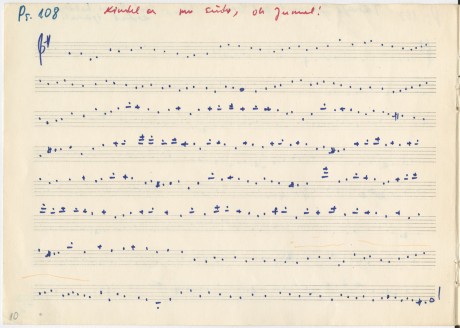
These sufferings are documented in Pärt’s musical notebooks or so-called musical diaries that Pärt started to use in 1974 to write down both his musical and verbal ideas. From these pages we see that the composer has drawn inspiration from many things, like Gregorian chant and early polyphony, scripture and prayers.

Pärt found his long searched own musical language in February, 1976 with a little piano piece Für Alina and in next two years he composed plenty of new works, like Cantus, Tabula rasa, Fratres, Spiegel im Spiegel, etc. He had created his original compositional technique which he called tintinnabuli and which has been the basis of his musical style up until today.

date:
2017
author:
Kai Kutman
copyright holder:
APC
Eight years of searching
MusicInMovement.org uses cookies to make the site simpler. Find out more about cookies