
MiM quiz – Explorer level / Education
Remember, this quiz is not about testing your knowledge about contemporary music. It's all about getting to know the four composers - their music, techniques, but also inspirations and private stories. We invite you to take on this challenge - discover the universe of four personalities and dive in into their music.
Vocal music - who composed this musical piece?
Listen to the short excerpt and recognize the composer.
The example comes from Pierre Boulez – Pli selon pli.
The example comes from Louis Andriessen La passione.
The example comes from Arvo Pärt – Kanon pokajanen.
The example comes from Kazimierz Serocki Poesies.
The four composers and film. To whom do the various descriptions apply?
Pierre Boulez’s music was not used in films as too complex, autonomous by nature and, consequently, not suited to illustrating anything.
Louis Andriessen liked to work with well-known directors (Peter Greenaway, Quay Brothers), although he did not write music “for films”, but, rather, co-created works with them in accordance with his own concept.
Arvo Pärt is one of those composers whose music is frequently used in films, choreographies, art and theatre projects,
Kazimierz Serocki’s film music legacy is substantial: from sound illustrations to documentaries to feature-length productions like Aleksander Ford’s The Teutonic Knights and Jerzy Hoffman's The Deluge.
The quotations come from other composers and music journalists. Whom they apply to?
xxx in the quotations replace the name of the composer in question.
George Benjamin (British composer) on Pierre Boulez– The Guardian, 20 March 2015
Bogusław Schaeffer (Polish composer) on Kazimierz Serocki - Kompozytorzy XX wieku tom 2 (Kraków, 1989)
Tom Service (music journalist) on Louis Andriessen – The Guardian, 15 October 2012
Steve Reich (American composer) on Arvo Pärt – Die Zeit, 11 September 2015
The four composers not only composed songs. To a smaller or bigger extent they also tried to influence the shape of the musical life in their countries and globally. To whom do the following statements refer?
Among Pierre Boulez's most important achievements are not only the artistic ones but also the creation of IRCAM, Ensemble Intercontemporain as a model of a new music ensemble and concert halls adapted to unconventional music performances, which he designed together with the architect Frank Gehry.
In the 60's and 70's Louis Andriessen, together with other artists, used to attack what he regarded as bourgeois and outdated forms of concert life, which he wanted to replace by the modes much better adapted to the needs of the modern society.
Hollywood but also indie directors like to use the magical music of Arvo Pärt to soundtrack their films. But he has not made any significant efforts towards influencing music life through creation or being part of institutions
Kazimierz Serocki was one of the founding fathers of the International Festival of Contemporary Music in Warsaw, referred to as “Warsaw Autumn”,
Read more about the "Warsaw Autumn Festival".
Orchestral music - who composed this musical piece?
Listen to the short excerpt and recognize the composer.
Instrumental color scheme also plays a major role in Pli selon pli composed by Pierre Boulez, but this piece sounds quite different from Serocki’s music. Boulez saw the precise pitch as equally important as harmony arrangements.
In Ad libitum the nature of the music resembles that of colour fantasia, like in many of Krzysztof Serocki’s works.
A vivid, though by no means simple rhythm, sound of the orchestra favouring the brass rather than the strings suggest Louis Andriessen – the example is taken from his Mysterien.
Consonant chords, melody and harmony bringing to mind Renaissance music in Arvo Pärt’s 3. Symphony are characteristics of many of his works.
Chamber music - which of the four composers wrote this musical piece?
Listen to the short exceprt and recognise the composer.
The example comes from Louis Andriessen Zilver.
The example comes from Kazimierz Serocki Swinging Music.
The example comes from Arvo Pärt – Es sang vor langen Jahren.
The example comes from Pierre Boulez – Le marteau sans maître.
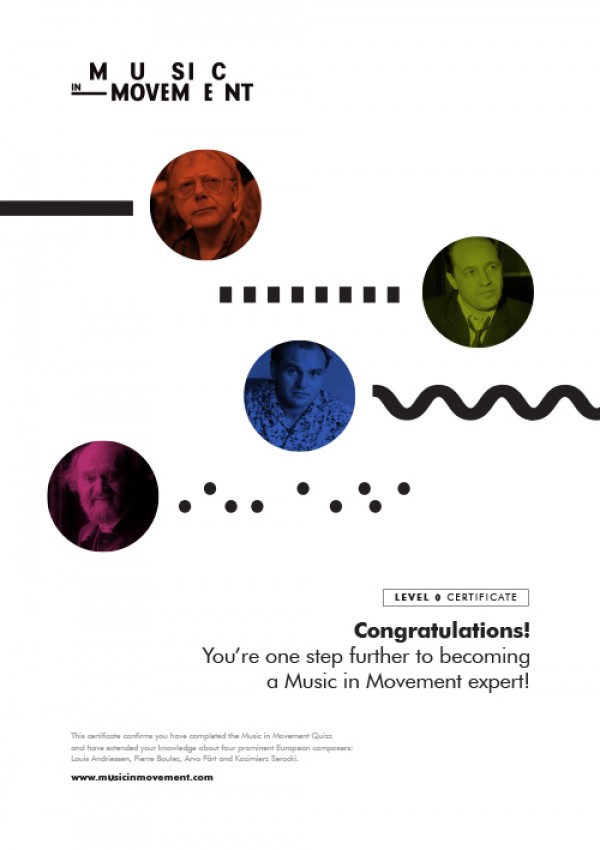
Well done!
We hope you enjoyed the experience!
You can now share & save your MiM certificate!